A clear and memorable online identity is essential, especially in the food industry. A .FOOD domain provides the perfect platform for restaurants, chefs, food bloggers, and culinary businesses to showcase their offerings, share recipes, or promote services. With a .FOOD domain, visitors instantly recognize the website’s focus, making it easier to build trust, attract the right audience, and stand out in a competitive market.
About .FOOD Domain Names
A .FOOD domain is designed for anyone connected to the culinary world, from restaurants and food brands to bloggers and nutrition experts. It instantly conveys the website’s focus, helping businesses and creators establish a professional, memorable online presence in the ever-growing food industry.
 What is a .FOOD Domain?
A .FOOD domain is a specialized domain extension created for businesses, organizations, and individuals in the food industry. This extension goes beyond traditional domain names like .com or .net by offering a clear, memorable identity that instantly communicates the website’s focus on food, dining, and culinary experiences. Whether it’s a restaurant, food blog, catering service, grocery delivery, or food product brand, a .FOOD domain adds credibility and clarity.
Using a .FOOD domain makes it easier for visitors to understand the website’s purpose immediately. It signals expertise and dedication in the food space, thereby improving trust and engagement. In addition, it enhances search engine visibility because search engines recognize relevant, descriptive domain extensions as helpful for users searching for related content.
This domain is not limited to businesses alone; it can also be used by culinary schools, food critics, recipe creators, and nutrition experts .FOOD domain helps in branding, making the website memorable, professional, and easy to find. It also enables a consistent online identity across social media and marketing channels, which is critical for growth in a competitive market.
History and Popularity of .FOOD Domains
The .FOOD domain extension was introduced as part of ICANN’s new wave of specialized top-level domains (TLDs), aiming to provide industry-specific options beyond generic domains. The idea was to offer a domain that clearly connects to the vast and diverse food sector, which is one of the most popular and widely searched topics online.
Since its launch, the .FOOD domain has steadily gained traction among restaurants, chefs, culinary bloggers, and food brands. Its popularity stems from the need to stand out. Traditional domains like .com are often saturated, making it hard to find a suitable, memorable name. The .FOOD domain solves this problem by allowing businesses to secure short, relevant, and brandable names that directly reflect their offerings.
Today, the domain is recognized globally, signaling authority and authenticity in the food industry. As online food services, delivery apps, recipe websites, and culinary influencers grow, demand for a clear, professional online presence has increased. A .FOOD domain provides exactly that, creating an instant association with quality and expertise in the food sector.
.FOOD Domain Name Registration
Registering a .FOOD domain is the first step to establishing a strong online presence in the food industry. It’s a simple and effective way to secure a memorable web address that reflects culinary expertise, attracts the right audience, and lays the foundation for a professional website.
Steps to Register a .FOOD Domain
Registering a .FOOD domain is straightforward and beginner-friendly. The first step is checking the availability of the desired domain name. This can be done on a domain registrar’s website, where the system will indicate whether the name is available or suggest alternatives if it’s already taken. Next, choose a reliable domain registrar. Established companies provide secure registration, transparent pricing, and easy management tools. After selecting the registrar, proceed to create an account by providing basic contact information. Accuracy is crucial because domain ownership records must be correct and up to date.
Once the account is set up, select the registration period. Many registrars offer options ranging from one year to multiple years. More extended registration periods can provide stability and reassurance for the website’s online presence. After this, complete the payment process securely. Most registrars accept credit/debit cards, PayPal, or other secure methods. Finally, configure domain settings such as DNS records, email forwarding, or web hosting integration. Once these steps are completed, the .FOOD domain is ready for use. It’s now possible to launch a website, connect it to social media, or build an online brand around a culinary identity.
Choosing the Right .FOOD Domain Name
Selecting the right .FOOD domain name is critical for branding, search visibility, and memorability. Start by keeping the name short, simple, and easy to spell. Complicated names or long phrases are harder to remember and more prone to typing errors, which can result in lost traffic. Focus on relevance. The name should clearly reflect the food-related services, products, or content. For instance, using words related to cuisine, dishes, ingredients, or cooking methods makes the domain intuitive for visitors and search engines alike. Avoid numbers, hyphens, or ambiguous words that could confuse potential visitors.
Consider brandability. A unique and creative name sets the website apart and creates a strong identity. Names that are catchy or playful often leave a lasting impression. Additionally, check for trademark conflicts to prevent legal issues and ensure smooth branding across digital platforms. Lastly, think long-term. A domain name should support growth and expansion. For example, a restaurant planning to open multiple outlets, or a food blog looking to expand into video content, should choose a versatile name that accommodates future growth. A carefully selected .FOOD domain becomes a powerful tool for online presence, marketing, and business growth in the competitive food industry.
.FOOD Domain Name Transfer
Transferring a .FOOD domain lets you move your domain from one registrar to another while keeping your website and email services intact. Understanding the transfer process ensures a smooth transition, avoids downtime, and helps maintain continuous control over your online presence.
How to Transfer Your .FOOD Domain
Transferring a .FOOD domain from one registrar to another is a straightforward process when done carefully. The first step is to unlock the domain at the current registrar. Domains are often locked by default to prevent unauthorized transfers, so unlocking is essential. After unlocking, request the authorization code (also called an EPP code), which acts as a password for the transfer.
Next, please select a new registrar and initiate the transfer process on their platform. You will be prompted to enter the authorization code and confirm your domain ownership. Once submitted, the current registrar will verify the transfer request, usually via email. Approval is required to proceed.
The transfer typically takes a few days to complete, during which the domain remains active, ensuring there is no website downtime. After the transfer is finalized, check that the domain settings, DNS records, and contact information are correctly configured at the new registrar. By following these steps, a .FOOD domain can be smoothly transferred while maintaining continuous online presence.
Common Issues in Domain Transfers
While transferring a .FOOD domain, several issues can arise. One of the most common problems is an expired domain or incorrect contact information, which can prevent the transfer from being approved. Make sure the domain is active and the registrant’s email address is up to date before initiating the process. Another frequent issue is a locked domain. If the domain is not unlocked, the transfer request will fail.
Similarly, using an incorrect or expired authorization code can halt the process. Registrar-specific policies may also delay transfers, so it’s important to check requirements in advance. Timing can be a factor too. Newly registered domains often have a 60-day transfer restriction imposed by ICANN, which can be surprising if overlooked. Being aware of these potential issues and preparing in advance ensures a smooth transfer without disrupting your website or email services.
.FOOD Domain Name Renewal
Renewing a .FOOD domain on time is essential to keep your website, email, and online brand active. Regular renewal ensures uninterrupted service, protects your domain from being claimed by others, and helps maintain a professional presence in the competitive food industry.
When to Renew Your .FOOD Domain
Renewing a .FOOD domain on time is essential to maintain uninterrupted website service and protect your online identity. Domains are registered for a specific period, typically one to ten years. It’s recommended to renew your domain before the expiration date to avoid downtime or loss of ownership. Most registrars provide reminders via email or dashboard notifications well in advance of the expiry date.
Renewing early can also protect your brand from competitors who may register the domain if it lapses. In addition, some registrars offer auto-renewal options to make the process hassle-free. Failing to renew a .FOOD domain on time can lead to a grace period, after which the domain may enter a redemption phase, often incurring additional fees. If it’s not recovered promptly, the domain can be released for public registration, potentially causing irreversible loss. Timely renewal ensures continuity for your website, email services, and brand reputation.
 How to Renew a .FOOD Domain
Renewing a .FOOD domain is simple. Start by logging into the registrar account where the domain is registered. Locate the domain management or “My Domains” section and select the domain for renewal. Choose the desired renewal period, typically 1 to 10 years.
Next, complete the payment process using the registrar’s secure payment options. Many registrars allow multiple payment methods, including credit/debit cards and digital wallets. After payment confirmation, the domain’s registration period is extended, and you’ll receive a confirmation notification.
For added convenience, consider enabling auto-renewal if available. This ensures the domain is automatically renewed before its expiry date, eliminating the risk of accidental lapses. Regularly reviewing contact information is also essential, as registrars rely on email notifications to inform them about upcoming renewals. Renewing your .FOOD domain on time protects your online presence and keeps your brand accessible to your audience without interruptions.
.FOOD Domain Name WHOIS
The WHOIS database stores essential information about the ownership and contact details of a .FOOD domain. Keeping this information accurate and secure is essential for managing your domain, receiving important notifications, and protecting your online presence from misuse or disputes.
How to Update Your WHOIS Information
The WHOIS database is a public record that stores key details about domain ownership, including the registrant’s name, contact information, and administrative and technical contacts. Keeping WHOIS information accurate for a .FOOD domain is crucial, as outdated details can lead to missed notifications about renewals, domain disputes, or other important updates. Updating your WHOIS information is simple. Log in to your domain registrar account and navigate to the domain management section.
Look for an option labeled “Update WHOIS” or “Manage Contact Information.” Make sure the name, email address, phone number, and mailing address are accurate and up to date. After making changes, save and confirm them. Some registrars may require email verification or additional confirmation steps to ensure the update is legitimate. Timely updates prevent administrative issues and help maintain ownership rights. Accurate WHOIS information also ensures compliance with ICANN policies, helping protect a .FOOD domain from suspension or dispute.
WHOIS Privacy Protection
WHOIS privacy protection is a service offered by many registrars to safeguard personal information in the public WHOIS database. For a .FOOD domain, this service replaces your contact details with anonymized information, protecting against spam, unsolicited calls, and identity theft.
While privacy protection keeps your personal information hidden, it does not affect your control over the domain. You still maintain full administrative rights and receive essential communications through your registrar. Some registrars allow easy toggling of privacy protection, so you can enable or disable it as needed. Using WHOIS privacy protection also helps maintain a professional image, especially for businesses that do not want personal addresses or phone numbers visible online. It is particularly valuable for individuals and small food-related businesses who want to minimize exposure while ensuring compliance with domain registration rules.
.FOOD Domain Registry Information
The .FOOD domain registry is the organization responsible for overseeing and managing all .FOOD domain names. It ensures the domains remain secure, reliable, and accessible, while working with accredited registrars to make registration, transfers, and renewals smooth and efficient.
The Role of the .FOOD Domain Registry
The .FOOD domain registry is responsible for managing the technical infrastructure, database, and overall administration of the .FOOD top-level domain (TLD). This includes maintaining accurate records, ensuring domain stability, and overseeing registration policies to ensure fair and secure domain allocation.
Registries coordinate with ICANN to enforce global domain regulations and maintain system reliability. They also provide the backbone for domain transfers, renewals, and WHOIS management. Essentially, the registry ensures that every .FOOD domain functions correctly on the internet, providing a stable, trusted platform for businesses, bloggers, and food enthusiasts alike.
By understanding the registry’s role, domain owners can appreciate the importance of choosing accredited registrars and following best practices for domain management. A reliable registry helps maintain security, uptime, and credibility for all .FOOD domains.
Accredited .FOOD Domain Registrars
Accredited .FOOD domain registrars are companies authorized by the .FOOD registry to sell and manage domain names. These registrars provide tools for registration, renewal, transfer, DNS management, and WHOIS updates.
Choosing an accredited registrar is essential because it guarantees secure transactions, reliable support, and compliance with ICANN and registry regulations. Accredited registrars often offer additional services like email hosting, privacy protection, and website-building tools, making it easier to manage your online presence.
Working with an accredited registrar ensures that a .FOOD domain is officially recognized, reducing the risk of fraud, loss, or disputes. It also makes processes like transfers and renewals smoother, providing peace of mind for businesses and individuals in the food industry who rely on their domain for branding, marketing, and customer engagement.
Technical Information for .FOOD Domain Name
Understanding the technical aspects of a .FOOD domain is essential for ensuring your website runs smoothly and securely. From DNS settings to advanced security features, proper configuration keeps your domain reliable, protects user data, and supports seamless online operations.
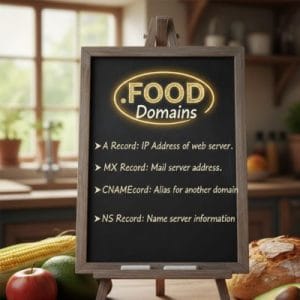 DNS Settings for .FOOD Domains
The Domain Name System (DNS) is the backbone of how the internet locates and connects to your .FOOD domain. Proper DNS configuration ensures that your website, email, and other online services function smoothly. For a .FOOD domain, DNS settings include A, CNAME, MX, and TXT records, each serving a specific purpose. A records point your domain to the server’s IP address, making your website accessible to visitors. CNAME records allow one domain name to redirect to another, which is helpful for subdomains or branded URLs.
MX records handle email routing, ensuring messages sent to your domain reach the correct mail servers. TXT records are used for verification and security, including SPF, DKIM, and DMARC, which help protect against email spoofing and spam. Managing DNS settings through your registrar’s dashboard is typically straightforward. Accurate and optimized DNS configurations reduce downtime, improve website performance, and enhance user experience. Regularly reviewing these settings also helps prevent technical issues and ensures that your .FOOD domain remains fully functional and reliable.
Security Features for .FOOD Domains
Security is critical for any domain, and .FOOD domains are no exception. Implementing security features protects your website, brand, and customers from cyber threats. One key feature is DNSSEC (Domain Name System Security Extensions), which prevents attackers from redirecting visitors to malicious websites by authenticating DNS responses.
SSL certificates are another essential security measure. They encrypt data transmitted between the website and users, making the site secure for online transactions and protecting sensitive customer information. Additionally, enabling two-factor authentication (2FA) on the domain registrar account adds an extra layer of protection against unauthorized access.
Regular backups and monitoring for suspicious activity further safeguard the domain. Using these security measures not only ensures safe operations but also boosts customer trust, which is crucial for food businesses that handle online orders, payments, and personal information.
Why Register a .FOOD Domain?
Registering a .FOOD domain gives businesses, bloggers, and culinary professionals a unique and memorable online identity. It clearly communicates a focus on food, enhances brand credibility, and helps attract the right audience.
Global Recognition of .FOOD Domains
A .FOOD domain provides instant global recognition, signaling to visitors that the website is dedicated to food-related content, services, or products. This clear and specific domain extension helps businesses, bloggers, and culinary experts stand out.
For restaurants, catering services, food brands, or recipe creators, a .FOOD domain establishes authority and professionalism. It instantly communicates the niche, making it easier for customers to remember and trust the website. Global recognition also facilitates cross-border marketing and partnerships, as a .FOOD domain is universally understood in the culinary industry.
Choosing a .FOOD domain conveys expertise and commitment, enhancing brand credibility and customer confidence. Whether the goal is local presence or international outreach, this domain extension strengthens visibility and ensures the website resonates with the right audience.
SEO Benefits of .FOOD Domains
A .FOOD domain can provide a significant boost to search engine optimization (SEO) efforts. Search engines favor domains that are descriptive and relevant to the website’s content, and having “.FOOD” signals clearly that the site is related to the food industry. This relevancy can improve rankings for food-related keywords and make the website more discoverable to users searching for culinary content, recipes, restaurants, or food products.
Additionally, a clear and brandable domain enhances click-through rates, as users are more likely to trust and click on a website that aligns with their search intent. Combining a .FOOD domain with high-quality content, proper meta tags, and optimized on-page SEO practices can help the site rank higher in search results. Over time, this leads to increased organic traffic, better online visibility, and stronger brand authority in the food industry.
How to Register a .FOOD Domain
Registering a .FOOD domain is the first step toward establishing a strong online presence in the food industry. Following a straightforward process and choosing the right domain name ensures the website is professional, memorable, and ready to attract the right audience.
Step-by-Step .FOOD Domain Registration Process
Registering a .FOOD domain is simple and can be completed in a few straightforward steps. Start by searching for your desired domain name using a trusted registrar’s search tool to check availability. If the name is already taken, most registrars offer alternative suggestions relevant to your search.
Once you find an available domain, create an account with the registrar by providing accurate contact information. This ensures proper domain ownership records and compliance with ICANN regulations. After account setup, select the registration period, which typically ranges from one to ten years. More extended registration periods provide stability and reduce the risk of losing the domain.
Next, complete the payment process using secure payment methods. After confirmation, the domain is officially registered and ready for use. Finally, configure domain settings, including DNS records, email forwarding, and web hosting integration, to launch your website seamlessly. Following this step-by-step process ensures a smooth registration experience and sets the foundation for a professional online presence in the food industry.
Best Practices for Choosing a .FOOD Domain Name
Choosing the right .FOOD domain name is crucial for branding, memorability, and search visibility. Keep the name short, simple, and easy to spell to avoid confusion and ensure visitors can easily recall it. Relevance is key. Use words that clearly reflect the type of food business, recipe content, or culinary service being offered. Avoid numbers, hyphens, or complex phrases that can make the domain harder to remember or type.
Consider brandability and uniqueness. A catchy or creative name sets the website apart and leaves a lasting impression on visitors. Also, check for trademark conflicts to prevent legal issues and ensure smooth marketing across digital platforms. Finally, think long-term. Choose a domain that can grow with the business or website, accommodating future expansions or new services; a carefully chosen .FOOD domain enhances visibility, credibility, and audience engagement while building a strong, professional online identity.
Why Manage Your .FOOD Domain Name with Us?
Managing a .FOOD domain with us ensures a secure, reliable, and hassle-free online presence. With advanced management tools, expert support, and additional services, we make it easy to keep your domain professional, protected, and fully optimized for your food business.
Domain Management Features
We offer comprehensive domain management services to simplify the administration of .FOOD domains. Features include DNS management, WHOIS updates, easy renewals, and secure transfer options. Users can manage all domain-related settings from a single, intuitive dashboard, ensuring complete control over their online presence.
Additional tools such as email forwarding, privacy protection, and auto-renewal help safeguard domains while minimizing administrative tasks. Our platform is designed to make domain management straightforward, secure, and reliable, allowing businesses and individuals to focus on growing their food brand rather than dealing with technical complexities.
Customer Support and Additional Services Offered by Us
We provide expert support for all aspects of .FOOD domain management, from registration to troubleshooting. The customer support team is readily available to answer queries, assist with DNS configurations, and guide users through transfers, renewals, and other domain-related processes.
Beyond domain management, we offer value-added services, including web hosting, website-building tools, and SSL certificates, to help businesses establish a complete online presence. With us, managing a .FOOD domain is seamless, secure, and backed by professional expertise, making it the ideal partner for anyone looking to grow their online food business effectively.
.FOOD Domain Name Business Benefits
Registering a .FOOD domain offers numerous advantages for businesses and individuals in the culinary world. From enhancing brand recognition to gaining credibility and online visibility, this domain extension helps establish a professional, memorable presence in the competitive food industry.
Brand Recognition and Recall
A .FOOD domain significantly enhances brand recognition and recall. By clearly indicating the website’s focus on food, this domain extension makes it easier for visitors to remember the brand and associate it with culinary expertise. Short, descriptive, and relevant domain names stick in customers’ minds, making repeat visits more likely.
For businesses like restaurants, catering services, food brands, or recipe blogs, a .FOOD domain immediately conveys professionalism and authenticity. It strengthens marketing campaigns, social media presence, and offline branding efforts by creating a consistent identity. A memorable domain also fosters trust among visitors, encouraging them to explore offerings, place orders, or subscribe to content. In essence, a .FOOD domain becomes a key element of a brand’s digital identity, helping it stand out.
Wide Acceptance in the Digital World
The .FOOD domain enjoys wide acceptance across digital platforms, from search engines to social media networks. Its clear and descriptive nature ensures visitors instantly understand the website’s niche, which can improve click-through rates and user engagement.
Globally recognized, the .FOOD extension signals credibility, making it easier to attract international audiences and build a professional online presence. Businesses and content creators can confidently use this domain across marketing materials, email addresses, and promotional campaigns, knowing that it will be understood and trusted by users worldwide. Widespread acceptance also helps with search engine optimization, as search algorithms favor relevant domains, boosting online visibility.
.FOOD Domain Name Alternatives
While a .FOOD domain is ideal for culinary businesses, other domain extensions are worth considering as well. Exploring alternatives ensures flexibility in branding, availability, and relevance, helping to find the best fit for your online presence.
Other Popular Domain Extensions
While a .FOOD domain is ideal for culinary businesses, other domain extensions can be considered as well. Popular alternatives include .COM, .NET, .ORG, and industry-specific TLDs like .KITCHEN, .RESTAURANT, or .CHEF. Each extension offers its own advantages, such as familiarity, credibility, or relevance to the niche.
For example, .COM is universally recognized and often preferred for its authority, while .ORG is associated with non-profit or educational food initiatives. Choosing an alternative depends on brand goals, audience perception, and the availability of the desired domain name.
When to Consider a Different Domain Extension
Consider a different domain extension if preferred .FOOD domain is unavailable, too long, or does not align with the brand identity. Alternative extensions may also be better suited to broader business goals, such as global reach or multi-industry branding.
Additionally, if the focus is on a specific service, like a catering business or restaurant chain, TLDs like .KITCHEN, .RESTAURANT or regional extensions can provide greater relevance. Assessing audience expectations, marketing strategies, and the impact of SEO helps determine whether a .FOOD domain or an alternative extension will best serve long-term branding and online visibility.
.FOOD Domain Name Features
A .FOOD domain comes with a range of features designed to make it both flexible and secure. From name length options to advanced security measures, these features help businesses, bloggers, and culinary professionals build a reliable, professional online presence.
Minimum and Maximum Length for .FOOD Domain Names
A .FOOD domain offers flexibility in choosing a name that best represents a business, blog, or culinary service. The minimum length for a .FOOD domain is two characters, while the maximum is 63 characters, not including the extension itself. This range provides ample room for creativity while ensuring the domain remains memorable and easy to type.
Shorter domains are ideal for branding and recall, as they are easier for visitors to remember and share. Longer domains can include descriptive phrases, keywords, or business-specific information, which may also improve search engine visibility. When selecting a domain, it’s crucial to balance length with simplicity. Too long or complex a name can confuse users or lead to typing errors.
Understanding these length requirements ensures that businesses, chefs, and food enthusiasts can secure domains that are both compliant and effective for online branding; choosing a concise and relevant .FOOD domain helps establish a professional identity and enhances audience engagement.
Security Features Available for .FOOD Domains
 Security is a critical consideration for anyone .FOOD domain. Essential security features include DNSSEC (Domain Name System Security Extensions), which prevents unauthorized domain redirection and protects visitors from malicious websites.
SSL certificates are another vital feature that encrypts data between the website and users, ensuring secure transactions and protecting sensitive customer information. Additional protections, such as registrar-level two-factor authentication (2FA) and privacy protection, safeguard the domain owner’s account and personal information.
These security measures are crucial for food businesses handling online orders, customer data, or payment information. By implementing robust security, a .FOOD domain not only protects the brand but also builds trust among visitors, encouraging engagement and loyalty.
.FOOD Domain Name Requirements
Registering a .FOOD domain requires meeting specific criteria to ensure compliance and proper use. Understanding eligibility and reserved and prohibited names helps secure a domain that is professional, trustworthy, and fully aligned with the food industry.
Eligibility Criteria for .FOOD Domains
The .FOOD domain is open to individuals, businesses, and organizations involved in the food industry. This includes restaurants, cafes, catering services, food bloggers, culinary schools, nutrition experts, and food product brands.
Registrants must provide accurate contact information and comply with ICANN policies. There are no strict geographic restrictions, making it accessible to food professionals and enthusiasts worldwide. Ensuring eligibility and accurate registration information helps maintain credibility and avoids potential disputes or domain suspension.
Reserved Names and Prohibited Terms for .FOOD Domains
Specific names and terms are reserved or prohibited when registering a .FOOD domain. Reserved names may include those related to government, international organizations, or specific trademarks, which the general public cannot register.
Prohibited terms often involve offensive language, misleading content, or names that could infringe on intellectual property rights: registrars and the .FOOD registry enforces these rules to maintain professionalism, security, and legal compliance within the domain space. Understanding these restrictions before registration ensures a smooth process and helps in selecting a suitable, compliant domain name.
.FOOD Domain Hosting Services by Us
Hosting a .FOOD domain with us provides a reliable, secure, and professional platform for your website. With easy setup, robust performance, and expert support, it ensures your online presence in the food industry is always accessible, protected, and ready to engage visitors.
Benefits of Hosting Your .FOOD Domain with Us
Hosting a .FOOD domain with us offers numerous advantages for businesses, bloggers, and culinary professionals. One of the primary benefits is reliability. We ensure that websites are fast, secure, and always accessible to visitors. With robust servers and uptime guarantees, your website remains online around the clock, which is essential for maintaining credibility and customer trust.
Another key advantage is enhanced security. We provide SSL certificates, daily backups, and advanced protection features to safeguard your website and customer data. This is especially important for food businesses that handle online orders or collect sensitive information.
We also offer easy-to-use management tools that let users configure their domains, email accounts, and databases through a simple dashboard. Additional benefits include scalable hosting plans that grow with your business, professional support for troubleshooting, and integration options for e-commerce, blogs, and marketing platforms. Hosting with us ensures a seamless online experience, so you can focus on creating high-quality content and serving customers.
How to Set Up Hosting for Your .FOOD Domain Name
Setting up hosting for a .FOOD domain with us is straightforward. Begin by purchasing a hosting plan that suits your website’s needs, whether it’s for a restaurant, food blog, or online store. After completing the purchase, log in to your account and navigate to the hosting section.
Next, link your .FOOD domain to the hosting account. This typically involves updating the DNS settings or nameservers provided by us. Once the domain is connected, you can set up email accounts, databases, and website files through the control panel.
We also provide one-click installations for popular content management systems (CMS) like WordPress, making it easy to launch a fully functional website quickly. For additional customization, users can manage themes, plugins, and security settings directly from the dashboard. With expert support available at every step, setting up hosting for a .FOOD domain is simple, secure, and efficient, ensuring the website is ready to attract and engage visitors.
Case Studies & Real-World Success Stories About .Food Domain Name
Case Study 1: Building Consumer Trust for a Direct-to-Consumer Organic Food Brand with a .FOOD Domain
Client Profile
The client was a fast-growing direct-to-consumer (D2C) organic food brand focused on packaged staples and ready-to-cook products. Operating in a highly competitive consumer market, the business was transitioning from early traction to a national growth phase, with increasing emphasis on brand trust, transparency, and online sales.
Challenge
As the brand scaled its digital presence, it faced credibility gaps common in the food industry. Consumers were cautious about ingredient sourcing, authenticity claims, and product safety. The existing domain name lacked industry relevance and did little to reinforce trust or clearly communicate that the website was an authoritative destination for food-related products. The client needed a domain strategy that reduced hesitation, improved brand recall, and aligned closely with consumer intent.
Solution
Hiya Digital conducted a brand and audience intent analysis, identifying trust and clarity as the top drivers of conversion. Based on this, we recommended transitioning to a concise, brand-aligned .FOOD domain.Our team supported the client through a structured implementation process:
- Mapping the new domain to core brand messaging around quality, sourcing, and transparency
- Ensuring a clean migration plan to preserve search equity and user experience
- Aligning on-site content and metadata to reinforce topical relevance in the food space
- Establishing governance practices to protect the domain and maintain brand integrity
The .FOOD extension clearly signaled industry focus while strengthening authority at the domain level.
Result
Within months of launch, the brand saw a measurable increase in user engagement and trust indicators. Direct traffic improved due to higher name recall, while product pages experienced stronger conversion rates driven by increased consumer confidence. The .FOOD domain became a foundational brand asset, supporting long-term growth and reinforcing the company’s position as a credible, food-first digital brand.
Case Study 2: Positioning a Culinary Education Platform as an Authority Using a .FOOD Domain
Client Profile
This client was a professional culinary education and content platform offering online courses, certifications, and expert-led resources for chefs, food entrepreneurs, and hospitality professionals. The organization operated at a mid-sized scale and was expanding globally, targeting learners across multiple regions.
Challenge
Despite strong content quality, the platform struggled to stand out in search results and professional circles. Its existing domain name was generic and did not reflect the depth or seriousness of its food-focused expertise. Prospective learners often perceived the brand as a blog rather than a credible education authority, limiting enrollment growth and partnership opportunities.
Solution
Hiya Digital approached the challenge from an authority-building perspective. After evaluating audience expectations and industry signals, we advised adopting a .FOOD domain to clearly anchor the platform within the global food ecosystem.The implementation focused on:
- Selecting a domain structure that emphasized expertise and professionalism
- Reframing the platform’s positioning around education, skills, and industry standards
- Supporting content realignment to strengthen topical authority under the new domain
- Establishing trust signals through consistent branding and structured content hierarchy
The .FOOD domain acted as a credibility marker, immediately communicating relevance to professionals and institutions.
Result
Post-migration, the platform experienced improved perception among both learners and industry partners. Course enrollment increased steadily, and inbound collaboration requests grew as the brand became more easily recognized as a serious authority on food education. Organic visibility for food-related educational queries strengthened over time, validating the domain choice as a strategic move rather than a cosmetic change.
Start Building Trust and Authority with a .FOOD Domain Today
Hiya Digital helps businesses in the food ecosystem choose and implement the right .FOOD domain as part of a long-term, growth-focused strategy. From brand alignment to seamless setup, our experts guide you at every step. Whether you’re launching, scaling, or repositioning your online presence, we ensure your domain works as a true business asset. Get clarity, confidence, and a strategy tailored to your goals. Request a free quote from Hiya Digital today and explore the full potential of a .FOOD domain for your brand.
Frequently Asked Qustions About .FOOD Domain Name
What is a .FOOD domain name?
A .FOOD domain name is a specialized top-level domain (TLD) created for websites connected to food, beverages, and related industries. Instead of using a general extension like .com or .net, this domain clearly signals that a website focuses on food in some form, whether that involves recipes, restaurants, catering, food delivery, agriculture, or food education. The extension itself instantly conveys purpose, making it easier for visitors to understand what the website is about before they even click.
From a branding perspective, a .FOOD domain helps create a strong and relevant online identity. It aligns the website name with its content, thereby improving clarity and trust. For beginners exploring domain options, this type of domain offers a straightforward way to match a website address to its core theme without resorting to lengthy or complex names.
What does a .FOOD domain represent?
A .FOOD domain represents everything related to food, nutrition, beverages, and culinary experiences. This includes cooking blogs, food brands, restaurants, grocery platforms, food startups, recipe-sharing communities, and even educational resources about nutrition and food safety. The extension acts as a clear label that connects the website directly to the food ecosystem.
Beyond simple categorization, a .FOOD domain also represents relevance and focus. Visitors often associate niche domains with expertise and authenticity. When a website address ends with .FOOD, expectations are set immediately, which can help build credibility and reduce confusion, especially in crowded online spaces.
Is a .FOOD domain suitable for all types of websites?
A .FOOD domain works best for websites that have a clear and direct connection to food or beverages. For food blogs, recipe platforms, restaurants, food delivery services, nutrition portals, or food-related businesses, this domain fits naturally and strengthens brand clarity. In these cases, the domain extension supports the content rather than distracting from it.
For websites unrelated to food, a .FOOD domain may not be suitable. Using a niche domain without a matching purpose can confuse visitors and weaken trust. Choosing a domain that aligns closely with the website’s topic always leads to better user understanding and long-term credibility.
What is the difference between a .FOOD domain and other TLDs?
The main difference between a .FOOD domain and general TLDs like .com or .org lies in specificity. A .FOOD domain immediately communicates the website’s focus, while general TLDs are broad and can represent almost any topic. This specificity helps attract the right audience and sets expectations clearly from the start.
Another key difference is branding flexibility. Many popular names are already taken on .com, making it harder to secure a short, meaningful address. With .FOOD, more relevant and memorable names are often available, allowing food-related projects to build a unique identity without compromises.
What is .FOOD domain name registration?
.FOOD domain name registration is the process of reserving a unique website name that ends with the .FOOD extension through an accredited domain registrar. Once registered, the domain becomes exclusively associated with the registrant for the chosen registration period, typically one year or more.
This registration gives control over how the domain is used, including linking it to a website, setting up email addresses, or redirecting traffic. It also protects the chosen name from being registered by others, which is essential for brand consistency and online security.
How does .FOOD domain name registration work?
The registration process starts with checking whether the desired .FOOD domain name is available. This is usually done through a domain registrar’s search tool. If the name is available, it can be added to a cart and registered by providing basic contact details and completing payment.
After successful registration, the domain is activated and can be connected to hosting services or other online tools. Management features such as DNS settings, renewals, and privacy options are typically handled through the registrar’s control panel, making the process accessible even for beginners.
How long does it take to register a .FOOD domain?
Registering a .FOOD domain usually takes only a few minutes once the payment is completed. In most cases, the domain becomes active almost immediately, allowing website setup to begin right away. This quick turnaround makes it convenient for new projects or time-sensitive launches.
In rare cases, additional verification may be required, which can delay activation slightly. Even then, the process typically takes no more than a few hours, keeping delays minimal.
What are the requirements to register a .FOOD domain?
The basic requirements for registering a .FOOD domain are simple. Accurate contact information is required, including a name, email address, and location details. This information is used for ownership records and domain management purposes.
No strict industry certifications or licenses are required for most registrations. As long as the domain name follows standard naming rules and the registration details are valid, the process remains open and accessible.
Who can register a .FOOD domain name?
Anyone can register .FOOD domain name with an interest in food-related content or services. This includes entrepreneurs, bloggers, startups, established brands, educational platforms, and organizations working within the food ecosystem.
The open registration model encourages creativity and innovation. Whether the goal is to share recipes, promote a food brand, or build an online marketplace, the domain is available without complex eligibility requirements.
Can individuals and businesses both register .FOOD domains?
Yes, both individuals and businesses can register .FOOD domains without restrictions. Personal projects such as food blogs, cooking portfolios, or nutrition journals can benefit just as much as commercial websites like restaurants, food delivery services, or packaged food brands.
This flexibility makes the .FOOD domain suitable for a wide range of goals. From small passion projects to large-scale business platforms, the extension supports clear messaging, audience trust, and long-term brand growth when used appropriately.
How much does .FOOD domain name registration cost?
The cost of registering a .FOOD domain can vary depending on the registrar, the domain name, and any additional services included during registration. Factors such as domain availability, registration period, and optional features like privacy protection or email forwarding can influence the final price. Because of these variables, the overall cost is not fixed across all providers.
It is always a good idea to review what is included in the registration before making a decision. Transparent pricing, renewal clarity, and included security features help ensure long-term value. Comparing a few trusted registrars can also help identify the best balance between cost and service quality.
Is the .FOOD domain registration price the same every year?
The registration price for a .FOOD domain may not always remain the same. Initial registration pricing can differ from renewal pricing, depending on the registrar’s policies and the domain type selected. Premium domains, in particular, often follow different pricing structures.
To avoid surprises, it is essential to check renewal terms at the time of registration. Precise knowledge of long-term pricing helps with better planning and prevents unexpected interruptions to a website’s online presence.
Can I register a .FOOD domain for multiple years?
Yes, a .FOOD domain can be registered for multiple years in advance. Many registrars offer flexible registration periods, allowing selection of a single year or several years at once. Multi-year registration helps reduce the need for frequent renewals.
Registering for a more extended period can also provide added peace of mind. It reduces the risk of accidental expiration and signals long-term commitment, supporting brand stability and trust.
What happens after I register a .FOOD domain?
After registration, the .FOOD domain becomes active and is officially assigned to the registrant. Access to a domain management panel is typically provided, allowing configuration of settings such as DNS records, email forwarding, and security features.
From there, the domain can be connected to a hosting provider to launch a website or used for professional email addresses. Ownership remains valid throughout the registration period, provided renewal requirements are met.
How can I check if a .FOOD domain name is available?
Domain availability can be checked through a domain registrar’s search tool by entering the desired name with the .FOOD extension, the system instantly shows whether it is available or already registered.
If the name is unavailable, alternative suggestions are often provided. These tools make it easy to explore variations without technical knowledge, helping beginners move forward with confidence.
What should I do if my desired .FOOD domain already taken?
When a preferred .FOOD domain is already registered; exploring slight variations can be a practical next step. Adding a relevant word, carefully adjusting spelling, or choosing a location-based term can help maintain clarity without losing brand meaning.
Another option is to check whether the domain is available for purchase from its current owner. In many cases, premium or resale options exist, though availability depends on the owner’s willingness to sell.
Can I buy a premium or already-registered .FOOD domain?
Yes, premium or already-registered .FOOD domains can often be purchased through registrars or domain marketplaces. These domains are considered valuable due to their short length, strong keywords, or brand appeal.
While premium domains may cost more, they can offer long-term branding advantages. Transparent ownership transfer processes and secure payment methods help ensure safe transactions.
How do I choose the best .FOOD domain name for my business?
Choosing the right .FOOD domain starts with clarity and simplicity. A name that clearly reflects the business’s food-related focus helps visitors understand its purpose instantly. Short, easy-to-spell names are easier to remember and share.
It is also wise to think long-term. Selecting a name that allows room for growth, avoids trends, and aligns with brand values can support credibility and a consistent online identity over time.
What is .FOOD domain name renewal?
.FOOD domain name renewal is the process of extending the domain’s ownership after the initial registration period ends. Without renewal, the domain can expire and eventually become available to others.
Renewal ensures uninterrupted access to websites, email services, and brand identity. Most registrars offer reminders and auto-renewal options to help prevent accidental domain loss.
When should I renew my .FOOD domain?
Renewal should ideally be completed before the domain’s expiration date. Renewing early helps avoid service disruptions and removes the risk of losing control over the domain.
Many registrars allow renewal well in advance, making long-term planning easier. Keeping renewal details up to date ensures continuous ownership and protects the online presence without unnecessary stress.
What happens if you forget to renew a .FOOD domain?
If a .FOOD domain is not renewed before its expiration date, the website and email services connected to that domain usually stop working. Visitors may see an error page, and any business emails linked to the domain can fail to deliver. This can lead to missed inquiries, lost trust, and confusion for customers who expect the site to be active.
After expiration, the domain enters a temporary inactive state under the registrar’s control. During this time, renewal is still possible, but action should be taken quickly. If no renewal occurs, the domain may move closer to deletion and eventually become available for someone else to register, resulting in permanent loss of the name.
Is there a grace period after .FOOD domain expiration?
Yes, most .FOOD domains include a grace period after expiration. This window allows renewal without losing ownership, even though the domain may not function normally during this time. The grace period exists to protect domain owners from accidental lapses and to give them time to restore the domain safely.
However, the grace period is limited and varies by registrar. Once it ends, recovery becomes more complex and may involve additional steps. Acting early during the grace period helps avoid unnecessary complications and ensures the domain stays securely under control.
How much does .FOOD domain renewal cost?
The renewal cost of a .FOOD domain is generally consistent with its standard renewal pricing and is set by the registrar. The exact amount can vary depending on the provider, the renewal duration, and any additional services, such as security or privacy protection.
It’s essential to review renewal terms in advance, as promotional pricing usually applies only to the first year. Keeping track of renewal details helps with budgeting and avoids unexpected interruptions to online presence or business operations.
Can auto-renewal be enabled for a .FOOD domain?
Auto-renewal can be enabled for a .FOOD domain through the domain management dashboard. Once turned on, the domain renews automatically before expiration, provided payment details remain valid. This feature helps prevent accidental expiration and service disruption.
Using auto-renewal is especially useful for business- or brand-related domains where continuity is essential. Regularly checking billing information ensures the auto-renewal process works smoothly and keeps the domain active year after year.
Can a .FOOD domain be renewed for multiple years at once?
Yes, a .FOOD domain can typically be renewed for multiple years in a single action. Multi-year renewals reduce the need for frequent renewals and add long-term stability to the domain’s ownership.
Renewing for several years at once is helpful for established websites and brands that rely on consistent online visibility. It also lowers the risk of accidental expiration and signals long-term commitment to search engines and users alike.
What is .FOOD domain name transfer?
A .FOOD domain transfer is the process of moving a domain from one registrar to another. This is often done to access better management tools, improved support, or preferred pricing while keeping the same domain name.
The transfer does not change the domain’s ownership. Instead, it changes the service provider managing it. Website content, email, and branding remain the same when the transfer is handled correctly.
When should a .FOOD domain be transferred to another registrar?
A transfer makes sense when current services no longer meet expectations, such as limited support, outdated tools, or a lack of transparency. It’s also common to transfer when consolidating multiple domains under one provider for easier management.
Transfers should be initiated well before the domain’s expiration date. Avoiding last-minute transfers reduces risk and ensures enough time to complete the process smoothly without interruptions.
How do you transfer a .FOOD domain name?
To start a transfer, the domain must be unlocked at the current registrar, and an authorization code must be requested. This code is then submitted to the new registrar to begin the transfer process.
Once initiated, confirmation emails are sent to verify the request. Approving these messages promptly helps move the transfer forward. Clear instructions are usually provided at each step to ensure a secure and accurate transfer.
How long does a .FOOD domain transfer take?
A .FOOD domain transfer typically takes several days to complete. The timeline depends on how quickly confirmations are approved and whether there are any delays from either registrar.
During this period, the domain remains registered and protected. Monitoring transfer emails and responding promptly helps ensure the process finishes as quickly as possible.
Is there any downtime during a .FOOD domain transfer?
In most cases, there is no downtime during a .FOOD domain transfer. The domain continues to resolve normally as long as the nameserver settings remain unchanged throughout the process.
To avoid any risk, it’s recommended to verify DNS settings before starting the transfer. Keeping everything consistent ensures visitors and email services continue to work without interruption while the domain changes registrars.
What are the requirements for transferring a .FOOD domain?
To transfer a .FOOD domain, it must be active and unlocked with the current registrar. An authorization code, also known as an EPP code, is required to confirm ownership and approve the transfer. The domain should also be past any initial registration lock period, which commonly applies to newly registered domains.
Accurate contact details are equally important because transfer approval emails are sent to the registered email address. Ensuring email access is available and monitoring inbox messages helps prevent delays. Meeting these basic requirements ensures the transfer process stays secure and smooth.
Does transferring a .FOOD domain extend its validity?
In most cases, transferring a .FOOD domain extends the current registration period by an extra year. This extension helps ensure the domain remains active throughout the transfer and beyond, reducing the risk of accidental expiration.
The added validity is applied automatically once the transfer is completed successfully. Checking the updated expiration date in the domain dashboard after the transfer provides explicit confirmation and peace of mind.
Is there a cost to transfer a .FOOD domain?
Yes, transferring a .FOOD domain usually involves a transfer fee. This fee often includes extending the domain’s registration period, adding value beyond simply transferring the domain to a new registrar.
The exact transfer terms depend on the chosen registrar. Reviewing transfer details in advance helps avoid surprises and supports better planning for domain-related expenses.
What is .FOOD domain name management?
.FOOD domain name management refers to controlling and maintaining all settings related to the domain from a central dashboard. This includes renewals, DNS configuration, security options, and updates to contact information.
Good domain management ensures the website, email services, and related tools work reliably. Proper oversight also helps protect the domain from misuse, accidental expiration, or technical errors.
What features are included in .FOOD domain management?
.FOOD domain management typically includes DNS control, domain locking, renewal options, and access to contact detail settings. These features allow complete control over how the domain connects to hosting, email, and other online services.
Additional tools may include domain privacy, auto-renewal, and security alerts. Together, these features make it easier to manage the domain safely while keeping online operations stable and uninterrupted.
How do you update .FOOD domain contact details?
Updating contact details for a .FOOD domain is done through the registrar’s domain management panel. Sections for registrant, administrative, and technical contacts make it easy to edit information such as name, email, and address.
Keeping contact details accurate is essential because important notices, renewal reminders, and security alerts rely on this information. Regular reviews help ensure no critical messages are missed.
How can DNS settings be managed for a .FOOD domain?
DNS settings for a .FOOD domain are managed through the DNS or nameserver section of the domain dashboard. This area allows changes to records such as A, MX, and CNAME records, which control website and email behavior.
Careful updates are essential because incorrect DNS changes can disrupt websites or emails. Following the provided instructions or using preset configurations helps maintain reliable performance.
Can a .FOOD domain be locked to prevent unauthorized transfers?
Yes, a .FOOD domain can be locked using a domain lock feature available in the management panel. When enabled, this lock prevents unauthorized transfer requests and adds an extra layer of protection.
Keeping the domain locked at all times, except during an intentional transfer, helps safeguard ownership. This simple security step significantly reduces the risk of domain theft or misuse.
How do you turn domain privacy on or off for a .FOOD domain?
Domain privacy settings can be managed from the domain control panel. A simple toggle usually enables or disables privacy protection, depending on preference and availability.
Turning privacy on hides personal contact details from public databases, while turning it off makes those details visible. Reviewing privacy settings regularly helps balance transparency and personal data protection.
What is WHOIS privacy for .FOOD domains?
WHOIS privacy for .FOOD domains replace personal contact information in public records with generic proxy details. This helps reduce spam, unwanted contact, and the risk of data misuse.
WHOIS privacy is especially valuable for individuals and small businesses that want to protect sensitive information. Enabling this feature supports safer domain ownership while maintaining complete control and compliance.
Is WHOIS privacy included with .FOOD domain registration?
WHOIS privacy is sometimes included with a .FOOD domain registration, but availability depends on the registrar. Some providers bundle it by default, while others offer it as an optional add-on. This feature controls whether personal contact details appear in public domain records.
Checking the registration details before purchase helps confirm what is included. Even when not bundled, WHOIS privacy can usually be enabled later through the domain management panel for added protection.
Why is WHOIS privacy important for a .FOOD domain?
WHOIS privacy protects personal and business contact details from public visibility online. Without privacy, information such as email addresses and phone numbers can be accessed by anyone, increasing exposure to spam and unwanted contact.
For food brands, restaurants, and online businesses, privacy also supports trust and professionalism. Keeping sensitive data protected reduces the risk of misuse while maintaining control over the domain.
How can a .FOOD domain be protected from hijacking or misuse?
The most effective way to protect a .FOOD domain is by enabling domain locking. This feature prevents unauthorized transfers and stops changes unless explicitly approved. Strong account passwords and secure login practices also play an essential role.
Additional protection comes from keeping contact details up to date and monitoring security alerts. These steps help ensure any unusual activity is noticed early and addressed before serious issues arise.
Is hosting needed to use a .FOOD domain?
Hosting is required only when a website needs to be displayed using the .FOOD domain. Hosting provides the server space where website files and content are stored, while the domain acts as the web address. Without hosting, the domain can still be owned and reserved for future use. This flexibility allows planning before launching a website.
Can a .FOOD domain be purchased without hosting?
Yes, a .FOOD domain can be purchased without hosting. Domain registration and hosting are separate services, and buying only the domain is common. This option works well when securing a brand name early or preparing for a future website launch. Hosting can always be added later when ready.
Can a .FOOD domain be used with any hosting provider?
A .FOOD domain can be used with almost any hosting provider. The domain is not tied to a specific hosting company, allowing complete freedom to choose or change providers at any time.
This flexibility is managed through DNS settings, which connect the domain to the chosen hosting server. As long as the correct details are entered, compatibility is not an issue.
How do you point a .FOOD domain to a hosting server?
Pointing a .FOOD domain to a hosting server involves updating nameservers or DNS records in the domain control panel. Hosting providers supply the required details, which are entered into the domain settings.
Once updated, changes may take some time to apply across the internet fully. After propagation, the domain will correctly load the website hosted on the server.
Can a .FOOD domain be used only for email services?
Yes, a .FOOD domain can be used only for email, not for a website. Custom email addresses can be created by configuring the appropriate mail records in DNS.
This setup is proper for food businesses that want professional email communication without maintaining a website. It enhances brand identity while keeping the setup simple.
What are the benefits of registering a .FOOD domain?
A .FOOD domain clearly communicates a connection to food, dining, or nutrition-related content. This clarity helps visitors instantly understand the website’s purpose, building relevance and trust at first glance.
The extension also supports strong branding by offering memorable and meaningful domain names. For food businesses, bloggers, and online services, this relevance can improve engagement and recognition.
Why is .FOOD considered a popular domain extension?
.FOOD is popular in the food and beverage space because it closely aligns with the industry it represents. Restaurants, food startups, recipe platforms, and delivery services often prefer it for its clear and descriptive nature.
Rather than being broad or generic, .FOOD creates instant context. This focus makes it a strong choice for niche branding, helping food-related websites stand out in a crowded online space.
Does a .FOOD domain help with SEO?
A .FOOD domain does not automatically boost search rankings, but it can support SEO in meaningful ways. Search engines prioritize content quality, relevance, site performance, and user experience over the domain extension alone. A .FOOD domain clearly signals what the website is about, which helps search engines and visitors quickly understand the niche.
This clear relevance can improve click-through rates when the domain appears in search results, especially for food-related queries. When combined with helpful content, proper on-page optimization, and a fast, secure website, a .FOOD domain fits naturally into a strong SEO strategy without creating any ranking disadvantage.
Is a .FOOD domain better for global businesses?
A .FOOD domain works well for global businesses because it is not tied to any specific country or region. The extension is universally understood and easily recognized across markets, making it suitable for international food brands, exporters, recipe platforms, or online food services.
Since search engines treat generic top-level domains equally worldwide, a .FOOD domain can rank in multiple countries when supported by localized content, proper language targeting, and international SEO practices. This flexibility makes it a strong option for brands planning cross-border growth.
Can a .FOOD domain improve brand credibility and trust?
A .FOOD domain can strengthen brand credibility by clearly aligning the domain name with the food industry. Visitors instantly know what to expect, reducing confusion and building confidence, especially for new or lesser-known brands.
Trust grows further when the domain is paired with transparent business information, secure browsing, accurate content, and consistent branding. A relevant domain extension like .FOOD helps reinforce professionalism, particularly for businesses focused on food quality, safety, or expertise.
What is the minimum and maximum length of a .FOOD domain?
A .FOOD domain must meet standard domain naming rules, which include a minimum of one character before the extension. Short names are often easier to remember and type, making them popular for branding and marketing.
The maximum length is typically 63 characters before “.food.” While longer names are technically allowed, shorter and clearer domain names are more user-friendly and perform better for brand recall and usability.
Can a .FOOD domain contain numbers or hyphens?
A .FOOD domain can include numbers and hyphens, as long as they follow standard domain rules. Numbers can be helpful for brands, locations, or product lines, while hyphens help separate words for clarity.
However, excessive use of numbers or hyphens can make a domain more challenging to remember and may erode trust among some visitors. Clean, readable names are generally better for branding, marketing, and long-term credibility.
Are there any restrictions on .FOOD domain names?
Most .FOOD domains are open for registration without strict industry licensing requirements. However, general domain rules still apply, including restrictions on offensive terms, trademark infringement, or misleading names.
Some names may be reserved or subject to review to prevent misuse or consumer confusion. Choosing a domain that accurately reflects the food-related purpose of the website helps avoid compliance issues and builds user trust.
Can a .FOOD domain name be changed after registration?
A registered .FOOD domain name cannot be changed directly. Once registered, the domain itself remains fixed. If a different name is needed, a new domain must be registered.
To ensure a smooth transition, the new domain can be linked to the existing website via redirects. This approach helps preserve traffic, search visibility, and user trust while allowing a brand update or rebranding effort.
Can a .FOOD domain be sold or transferred?
A .FOOD domain can be sold or transferred to another owner, as long as registrar policies and registry rules are followed. This process usually involves unlocking the domain and completing a formal transfer.
Domain ownership transfers are shared for business sales, brand acquisitions, or portfolio management. Using a reputable registrar and keeping ownership details accurate helps ensure a secure and smooth transfer.
What support is available for .FOOD domain issues?
The domain registrar typically provides .FOOD domain issues. This includes help with registration, renewals, DNS settings, transfers, and security features.
Many registrars also offer documentation, live chat, or ticket-based support. Choosing a provider with reliable customer service ensures quick resolution of technical or administrative issues.
How is a lost or expired .FOOD domain recovered?
When a .FOOD domain expires, it usually enters a grace period during which renewal is still possible without losing ownership. Acting quickly during this phase prevents complications.
If the domain passes the grace period, a redemption phase may apply, often with additional fees. Once fully released, the domain becomes available for public registration, so timely renewal is essential to avoid permanent loss.
What happens if a .FOOD domain is suspended?
A .FOOD domain may be suspended due to issues such as non-payment, policy violations, or inaccurate registration details. During suspension, the website and associated services may stop working.
Restoring the domain usually involves resolving the underlying issue, such as updating information or completing payment. Maintaining accurate records and adhering to domain policies helps prevent unexpected disruptions.
Where can all domains be managed in one place?
All domains can be managed through a single domain registrar dashboard. Most registrars provide tools for renewals, DNS records, security settings, and transfers from a single central location.
Using one trusted provider simplifies domain management and reduces the risk of missed renewals or configuration errors. Centralized control also supports better security and long-term domain planning.