
Domain Portfolio Management – Dedicated Expert For Every Domain
Domain Names are spread across multiple registrars. DNS records nobody’s touched in years. Renewal emails are going to a former employee’s inbox. We audit, consolidate, and manage your entire portfolio, with a dedicated account manager, an 8-point risk audit, and 24/7 monitoring. Get a free portfolio assessment to start.



1700+
40+
24/7
99.95%
*Hiya Domains is owned and operated by Hiya Digital Private Limited.
What Is Domain Name Management?
Domain name management is the ongoing, systematic process of registering, renewing, organizing, configuring, monitoring, and securing all the domain names your business owns. It is not a one-time task; it is a continuous operational function that needs to be actively managed to protect your online presence.
In practice, domain name management covers:
- NRegistering new domain names across gTLDs and ccTLDs as your business grows
- NTracking expiry dates and handling renewals before domains lapse
- NConfiguring DNS records (A, AAAA, MX, CNAME, TXT, SRV, NS) correctly for all services
- NApplying and maintaining domain locks to prevent unauthorized transfers
- NKeeping WHOIS registrant, administrative, and technical contact data accurate
- NMonitoring domains for unexpected changes, hijacking attempts, or zone file modifications
- NConsolidating domains from multiple registrars into a single managed account
- NManaging domain transfers, backorders, auctions, and aftermarket acquisitions
- NRunning domain portfolio audits to assess risk, redundancy, and brand coverage gaps
For small businesses managing 5–10 domains, this can be done manually with care. For businesses with 50, 100, or 1,000+ domains, manual management becomes error-prone, time-consuming, and costly. That is where a managed domain name management service like Hiya Domain makes a difference.
What Is a Domain Portfolio Audit?
A domain portfolio audit is a structured, detailed review of every domain name your organization owns. The objective is to assess whether each domain is actively serving your business, correctly configured, properly secured, and strategically positioned, and to identify anything that needs fixing, dropping, or adding
A professional domain portfolio audit is typically triggered by:
- NAn upcoming brand review or rebrand
- NA merger, acquisition, or company restructure
- NConcern that domains may have been lost, compromised, or misconfigured
- NA desire to reduce costs by dropping redundant or unused domains
- NPreparation for entry into new markets or product categories
- NAn IT or security review that includes digital asset management
Our domain portfolio audit examines every domain across eight core areas:
| Audit Area | What We Examine |
|---|---|
| Ownership & Registrant Data | Are registrant, admin, and tech contact details accurate, current, and assigned to the correct legal entity, not a former employee or third-party agency? |
| Expiry Dates & Renewal Risk | Which domains are at risk of expiry within the next 30, 60, or 90 days? Are auto-renewals configured and funded? |
| DNS Configuration & Health | Are all DNS records (A, MX, CNAME, TXT, NS) correctly set up? Are there dangling DNS entries pointing to resources that no longer exist? |
| Domain Locks & Transfer Security | Are registrar-level locks (Transfer Lock, Update Lock) in place? Is the domain protected from unauthorized transfer or modification? |
| Redundant & Unused Domains | Are you paying for domain names that point nowhere, serve no strategic purpose, and could be dropped to reduce cost? |
| Brand Coverage Gaps | Are the most important TLD variants of your brand name registered? (.com, .net, .org, .biz, relevant new gTLDs) |
| WHOIS Privacy & Data Compliance | Is registrant contact data unnecessarily exposed in public WHOIS lookups? Is privacy protection applied where appropriate? |
| SSL & Redirect Status | Do all domains redirect correctly to your main site? Are SSL certificates active and not approaching expiry? |
At the end of the audit, you receive a written report with a risk rating for each domain, a clear list of recommended actions, and a prioritized plan to address the most urgent issues first.
Why Businesses Need Professional Domain Name Management
Most businesses accumulate domain names over time without a clear strategy. A domain is registered during a product launch here, a few more picked up during a rebrand there, some defensive registrations made when a new TLD launched, and before long, domains are scattered across multiple registrar accounts, with different expiry dates, different contact details, and no single owner responsible for all of them.
Here is what typically happens without active domain portfolio management:
Common Domain Management Failures and What They Cost

A domain expires while the renewal email goes to a former employee’s inbox. A cybersquatter registers it within hours, and you have to pay thousands to buy it back or lose it permanently.

DNS records are not updated after a server migration. Email stops working for days before anyone traces the problem back to an MX record pointing to the wrong server.

Your WHOIS records still show the email address of an agency that managed your domains three years ago. When the registrar sends a critical verification email, nobody receives it, and your domain is suspended.

Our internal audit shows that you are paying annual renewals on 40 domains that point to nothing and serve no purpose, a waste of budget that could have been freed up years ago.

A domain consolidation project reveals that two different registrar accounts hold overlapping versions of your brand domain (with and without hyphens, different TLDs), each with different DNS settings and different renewal contacts.
These are not edge cases. They are common, real-world problems that our clients come to us to fix and prevent. Professional domain name management addresses all of them proactively, before they become crises.
Our Domain Name Management Services
Hiya Domain offers a complete, end-to-end domain name management service. Here is what is included:
Domain Registration Across All Extensions
We register new domain names on your behalf across every major domain extension generic TLDs (gTLDs) such as .com, .net, .org, .info, and .biz; all major country-code TLDs (ccTLDs); and new gTLDs launched in recent ICANN rounds, including .tech, .store, .online, .digital, .agency, .app, .cloud, and hundreds more.
We advise on which extensions are strategically worth registering to protect your brand, and which you can safely skip. This ensures you get the coverage you need without paying for extensions that add no value.
Domain Renewal Management & Expiry Monitoring
For organizations that manage domain renewals in-house, we can provide a renewal calendar and advisory service, flagging upcoming renewals and any domains worth reviewing before renewal.
Domain Consolidation
We handle the transfer process end-to-end, including obtaining authorization codes, managing the transfer timeline, and verifying that DNS settings are carried over correctly so nothing breaks.
DNS Management & Configuration
Our premium managed DNS service includes anycast routing across a global network of DNS servers for faster query resolution from anywhere in the world, redundant infrastructure for high availability, and 24/7 monitoring with instant alerts if a DNS record changes unexpectedly or a zone becomes unreachable.
We also configure DNSSEC (Domain Name System Security Extensions) for domains where supported, adding a cryptographic layer of verification to prevent DNS spoofing and cache poisoning attacks.
Domain Security & Access Control
We also review and harden access controls on your registrar account: enabling two-factor authentication, restricting IP access where available, reviewing API key exposure, and auditing which individuals and systems can make domain changes.
As part of our domain security audit, we check for common vulnerabilities, including subdomain takeover risks (where a DNS record points to a cloud resource that no longer exists and could be claimed by a third party), open DNS resolvers, and dangling CNAME entries.
WHOIS & Registrant Data Management
We audit and maintain WHOIS data across your entire portfolio, ensure that your organization (not an individual employee or agency) is listed as the legal registrant, and apply WHOIS privacy protection where supported and appropriate to mask public contact details from spam and phishing harvesting.
We also ensure that registrant email addresses are monitored and functional, not pointing to inactive inboxes where critical domain verification emails would be missed.
Domain Aftermarket Services
Beyond standard domain registration and management, we provide a full range of domain aftermarket services for organizations that need to buy, sell, or recover domain names:
- Domain Backorder: We queue your registration request for a domain that is currently registered but approaching expiry. As soon as it drops, we will register it on your behalf to give you the best chance of acquiring it.
- Domain Auction & Bidding: We participate in domain auctions on your behalf, setting bid limits and a strategy to secure valuable domain names at competitive prices.
- Domain Brokerage: We negotiate the acquisition of premium or privately-held domain names on your behalf, leveraging our industry relationships to reach sellers and structure favorable purchase terms.
- Domain Escrow: We facilitate safe, secure domain transfers for high-value purchases through domain escrow services, ensuring the domain is delivered before payment is released, protecting both the buyer and the seller.
Brand Protection & New TLD Monitoring
We also monitor existing TLDs for third-party registrations that incorporate your brand name, trademark, or key product names and alert you to potential cybersquatting, typosquatting, or infringing registrations that warrant a response.
On-Demand Domain Portfolio Audit
Audits can be commissioned on demand, for example, ahead of a rebrand, merger, or security review, or scheduled regularly (quarterly or annually) as part of an ongoing managed service agreement.
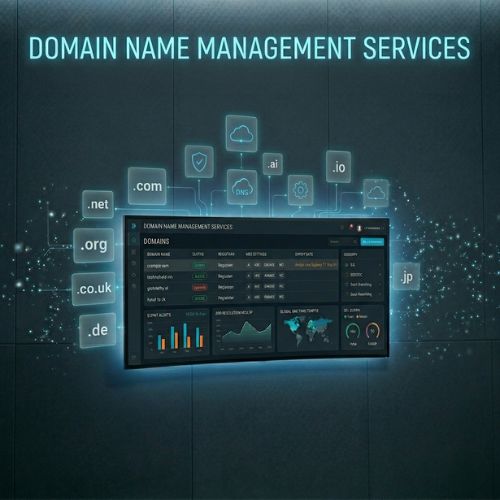
What Is Included in Your Domain Management Plan
Every domain management plan from Hiya Domains includes:

Dedicated Account Manager
A named expert who knows your portfolio and is your single point of contact for all domain matters

24/7 Domain Monitoring
Continuous monitoring of your domains for expiry risk, DNS changes, and security events, with priority alerts

Centralized Client Control Panel
A single dashboard to view your entire domain portfolio, check renewal dates, and manage settings

Free & Premium Managed DNS Options
Choose the level of DNS service that matches your traffic and uptime requirements

Annual Renewal Pre-Order Service
We pre-order renewals well in advance, so no domain is ever at risk of an accidental lapse

On-Demand Portfolio Audit Reports
Request a full portfolio audit at any time with written findings and actionable recommendations

Aftermarket Services Available
Backorder, auction, bidding, brokerage, and escrow are handled by our in-house team

Bulk Domain Management Tools
Designed to handle portfolios of any size efficiently

WHOIS Privacy Protection
Applied where available and appropriate to protect registrant contact data

All gTLD, ccTLD, and nTLD Extensions Covered
Every major global domain extension under one platform

Domain Security Audit
Access control review, lock status, DNSSEC assessment, and subdomain vulnerability check
Who Is This Service For?
Our domain name management and domain portfolio audit services are designed for organizations of all sizes that take their online presence seriously. Specifically:

Enterprises & Large Corporations
Managing 100+ domain names across multiple brands, products, subsidiaries, and geographies. Require centralized control, audit trails, and compliance reporting.

Growing SMEs
Have accumulated domains over time across multiple registrars and need to get organized, eliminate redundancies, and establish a clear domain strategy.

Legal, IP & Trademark Teams
Need accurate portfolio records, brand coverage analysis, and fast response capability for cybersquatting or infringing domain registrations.

Marketing & Digital Teams
Launching campaigns, microsites, and new products that require fast domain setup, reliable DNS, and consistent redirect management.

IT & Infrastructure Teams
Responsible for DNS integrity, uptime, and domain security. Need robust monitoring, DNSSEC, access control auditing, and fast incident response.

Startups & New Businesses
Building their brand from scratch, they want to register all the right domain extensions from day one, without risking gaps a competitor can exploit later.
Take Control of Your Entire Domain Portfolio
Stop juggling multiple dashboards and logins. Centralize all your domains in one place for complete visibility, control, and effortless management.
How Our Domain Portfolio Audit & Onboarding Process Works
Getting started is straightforward. Here is our standard five-step process:
Discovery & Full Inventory
We work with you to compile a complete list of all domain names your organization owns, including those held across different registrar accounts. We use WHOIS lookups, registrar account exports, and your internal records to ensure nothing is missed. For large portfolios, we provide a structured template for efficiently gathering data.
Domain Portfolio Analysis
We run every domain through our structured audit checklist: expiry status, DNS record accuracy, security lock status, WHOIS data quality, redirect health, SSL status, and brand coverage. We identify risks, gaps, redundancies, and quick wins.

Audit Report Delivery
We deliver a written audit report that covers every domain individually, with a risk rating (High / Medium / Low) and a specific recommended action for each. The report also includes a portfolio-level summary with priority actions and estimated cost savings from dropping redundant domains.
Implementation & Onboarding
We implement the audit recommendations: renewing at-risk domains, correcting DNS records, applying security locks, updating WHOIS data, and transferring domains onto our platform. We manage the entire process and verify that every change is tested and confirmed working before closing it out.
Ongoing Managed Service
Once onboarded, we manage your portfolio on an ongoing basis. Renewals are handled automatically. DNS changes are made on request and logged. Security monitoring runs continuously. You receive regular updates and can request a new audit at any time.

Why Choose Hiya Domain for Domain Name Management?
We are not a self-service platform where you register a domain and handle the rest yourself. We are a managed service provider, a team of domain professionals who take full responsibility for your portfolio and act as an extension of your team.
| What Makes Us Different | What It Means for You |
|---|---|
| Dedicated Domain Expert Team | You are not dealing with a generalist support team. Our team has deep expertise in domain name management, DNS, aftermarket transactions, and domain law. |
| All Extensions on One Platform | Every gTLD, ccTLD, and new gTLD under one account and one invoice, no need to manage relationships with multiple registrars. |
| Customized to Your Portfolio | We tailor our service to your portfolio size, risk profile, brand complexity, and internal team capacity, not a rigid, one-size-fits-all plan. |
| Full Aftermarket Capability | Backorder, auction, brokerage, and escrow services are all available in-house, with no need to use separate third-party platforms. |
| 24/7 Monitoring & Priority Support | Round-the-clock monitoring means issues are caught and resolved fast, including outside business hours when domain incidents are often first discovered. |
| Transparent Reporting | Regular audit reports and renewal calendars give you a clear, always-current picture of what you own, what it costs, and whether it is serving your business. |
| Country-Specific Expertise | We understand the ccTLD domain landscape, ccTLD policies, registry requirements, business compliance needs, and the local market context for brand protection |
Verified Customer Testimonials


Frequently Asked Questions About Domain Name Management & Domain Portfolio Audit
Below are detailed answers to the questions we hear most often from businesses exploring domain name management and domain portfolio audit services.
What is the difference between domain name management and domain portfolio management?
Domain portfolio management is the broader, strategic level of oversight across all the domain names your organization owns. It includes deciding which domains to register, which to let expire, which TLD variants of your brand name are essential to own, how to structure your portfolio across products and geographies, and how to use your domain portfolio proactively to protect and strengthen your brand online.
At Hiya Domain, we provide both. Operational domain name management is handled day-to-day by our team, and strategic domain portfolio management is built into every client relationship through regular audits, advisory conversations, and proactive monitoring.
How many domain names should my business own?
- Your primary brand name in .com, .net, and .org (if you are a global business) and top ccTLD extensions (if you are primarily a local business)
- Common misspellings or typo variants of your brand name, particularly if they would be easy for customers to confuse
- Your brand name in relevant industry-specific new gTLDs (for example, .tech, .store, .agency, .digital) if those extensions are actively used in your sector
- Product or service names that are important to your business and could be targets for cybersquatters
- Any domain names with existing SEO value or established traffic
We do not recommend registering every possible TLD defensively; that approach can be costly and is often unnecessary. Our domain portfolio audit helps you identify which domains are genuinely valuable to own and which registrations you can drop without meaningful risk.
What happens if a domain I own expires?
-
Grace Period (typically 0–45 days):
The domain has expired but can still be renewed by the current registrant, usually at the standard renewal price. Your website and email may stop working during this period, depending on the registrar. -
Redemption Period (typically 30 days after the grace period):
The domain can still be recovered by the original registrant, but typically at a significantly higher redemption fee, sometimes several thousand rupees above the standard price. -
Pending Delete (typically 5 days):
The domain is queued for deletion. During this period, it cannot be renewed or transferred by anyone. -
Released for General Registration:
The domain becomes available for anyone to register. Cybersquatters and automated drop-catching services monitor domain expiries and can register a dropped domain within seconds of it becoming available.
If one of our managed domains approaches expiry, we alert you well in advance and automatically handle renewal for domains enrolled in auto-renewal. Losing a domain while it is under our management is something we take very seriously and work hard to prevent entirely.
Can you manage domains that are currently registered with other registrars?
If you have specific reasons for keeping certain domains with their current registrar, for example, a domain locked in a transfer restriction period, or a registry-specific domain where transfer is not straightforward, we can provide monitoring and advisory services for those domains without requiring a transfer. Our goal is to deliver the best possible management outcome for your portfolio, regardless of the registrar situation.
What is DNS management, and why does it matter for my business?
DNS management involves configuring and maintaining the DNS records that tell the internet where your services are located. The most important DNS record types include:
- A records point your domain to your web server’s IPv4 address.
- AAAA records point your domain to your web server’s IPv6 address.
- MX records direct email for your domain to the correct mail server.
- CNAME records create aliases from one domain or subdomain to another.
- TXT records are used for email authentication (SPF, DKIM, DMARC) and domain verification.
- NS records specify which name servers are authoritative for your domain.
- CAA records specify which certificate authorities are allowed to issue SSL certificates for your domain.
Misconfigured DNS can cause your website to go down, email to stop being delivered or received, SSL certificates to fail validation, and services to become unreachable. Correct, well-monitored DNS is foundational to every online service your business depends on. We configure, test, and monitor DNS for every domain we manage.
What is a domain lock, and should all my domains have one?
Most reputable registrars enable domain locks by default, but this is not universal, and locks can be accidentally or intentionally disabled. As part of our domain security audit, we verify the lock status of every domain in your portfolio.
In general, yes, every domain you own and intend to keep should have a transfer lock enabled. The only time a domain lock should be temporarily turned off is when you are initiating a legitimate domain transfer that you have explicitly authorized. Our team manages the locking and unlocking process for any transfer we handle on your behalf.
What is WHOIS privacy protection, and do I need it?
WHOIS privacy protection (also called WHOIS masking or domain privacy) replaces your personal contact details in the public WHOIS record with proxy or privacy service contact details, while still ensuring that legitimate communications (such as legal notices or registrar communications) are forwarded to you.
Whether you need it depends on your situation:
- Individual domain owners and small businesses often benefit from WHOIS privacy to reduce spam, cold calls, and phishing attempts targeting their contact details.
- Large corporations and enterprises typically have their organization name and a generic contact email in WHOIS. In this case, privacy protection is less critical from a spam perspective. However, it is still worth reviewing whether any individual employee’s personal details are unnecessarily exposed.
- Note: WHOIS privacy protection does not mean your ownership of the domain is hidden for legal or dispute purposes. ICANN maintains access to underlying registrant data for legitimate dispute resolution processes.
We assess WHOIS privacy settings as part of our domain portfolio audit and make recommendations based on your organization type and risk profile.
What is cybersquatting, and how can domain management help prevent it?
Common forms of cybersquatting include:
- Registering an exact brand name in a TLD that the brand has not registered (e.g., your brand on .net when you only own .com).
- Typosquatting registers common misspellings of your brand name to capture mistyped traffic.
- Registering your brand name in a new TLD as soon as it launches, before you have had a chance to register it yourself.
- Registering domains that combine your brand name with words like ‘scam’, ‘review’, ‘support’, or ‘complaints’ to create reputation damage.
Domain name management helps prevent cybersquatting by ensuring you own the most important TLD variants of your brand name before a third party can register them. Our brand monitoring service also alerts you when a potentially infringing registration is detected so that you can take action early. When cybersquatting occurs, we can advise on dispute resolution options, including the UDRP (Uniform Domain-Name Dispute-Resolution Policy) and URS (Uniform Rapid Suspension).
How often should I run a domain portfolio audit?
-
Annual audit:
Suitable for most small to mid-sized businesses with a stable portfolio of fewer than 50 domains. An annual review keeps the portfolio clean, identifies upcoming renewal risk, and checks for any changes that need attention. -
Bi-annual audit (every 6 months):
Recommended for businesses with 50–200 domains, or for businesses in fast-moving sectors where brand strategy, product lines, or market presence are evolving regularly. -
Quarterly audit:
Advisable for enterprises with large portfolios (200+ domains), businesses going through a rebrand or merger, or organizations with active brand protection concerns and ongoing cybersquatting monitoring needs. -
On-demand audit:
Appropriate any time a significant business event occurs, such as a company acquisition, a new product launch, a legal dispute involving domain names, or a suspected security incident.
At Hiya Domain, we offer both on-demand and scheduled audit services, and our ongoing managed service clients receive regular portfolio reviews as part of their plan.
What domain extensions should my business register?
For most businesses, these are the key types of domain extensions to consider:
.com
The most globally recognized and trusted domain extension. A .com domain is often considered essential for brand credibility, international visibility, and customer confidence.
Country-Code TLDs (ccTLDs)
Businesses serving customers in specific countries should strongly consider registering the relevant local country ccTLDs.
- .uk for the United Kingdom
- .de for Germany
- .au for Australia
- .ae for the UAE
- .sg for Singapore
- .in for India
Local ccTLDs can improve regional trust, support localized marketing strategies, and strengthen geographic search relevance in local search results.
Industry-Specific and New gTLDs
Depending on your industry and branding strategy, newer domain extensions may help reinforce brand positioning or create more relevant marketing campaigns.
- .tech
- .store
- .agency
- .app
- .cloud
- .digital
Defensive Domain Registrations
Businesses should also consider registering:
- common misspellings
- typo variations
- key brand variations
- important regional extensions
- high-risk TLDs related to their industry
This helps reduce the risk of cybersquatting, impersonation, phishing attacks, and brand abuse.
Choosing domain extensions is not only about protecting your brand but also part of a broader digital strategy involving SEO, international expansion, customer trust, and long-term domain governance.
Our Domain Portfolio Audit Services include a comprehensive domain coverage and risk assessment to help identify:
- missing domain extensions
- brand protection gaps
- unnecessary registrations
- regional expansion opportunities
- defensive registration needs
- domain security risks
This gives your business a clearer understanding of which domain extensions are strategically important and which gaps may expose your brand to operational or reputational risk.
What is DNSSEC, and does my domain need it?
Without DNSSEC, DNS is vulnerable to attacks such as:
- DNS cache poisoning: An attacker injects false DNS data into a resolver’s cache, redirecting users to a fraudulent website.
- Man-in-the-middle attacks, in which an attacker intercepts DNS queries and returns false IP addresses, intercepting traffic intended for your domain.
DNSSEC prevents these attacks by digitally signing DNS records, allowing resolvers to verify that the response they received is authentic and has not been tampered with.
Not all TLDs support DNSSEC, and even where it is supported, not all registrars implement it. For organizations handling sensitive customer data, financial transactions, or enterprise communications, DNSSEC is a worthwhile security layer. We assess DNSSEC status as part of our domain security audit and can configure it for domains that support it.
What is a subdomain takeover, and how do we protect against it?
If the external service has been decommissioned but the DNS record still exists, an attacker can register the abandoned resource on a third-party platform and effectively take control of your subdomain, serving content from your domain that you cannot control. This is commonly used in phishing attacks, where the attacker serves a fake login page under a subdomain that appears to be a legitimate part of your brand domain.
Protection against subdomain takeover involves:
- Regularly auditing DNS records to identify CNAME entries pointing to external services
- Removing or updating DNS records whenever an external service is decommissioned
- Monitoring for subdomain takeover indicators using automated tools
- Applying strict change management processes for DNS modifications
We include subdomain takeover risk assessment in our DNS security audit and flag any vulnerable entries for immediate remediation.
What is a domain backorder, and when should I use it?
When you place a backorder, we continuously monitor the domain’s status. The moment the domain enters the deletion queue and is released for general registration, we attempt to register it on your behalf, often within seconds of it dropping. Because many domain drop-catching services operate simultaneously, there is no guarantee of success, but a professionally managed backorder gives you a significantly better chance than attempting a manual registration.
Good use cases for domain backorder include:
- Recovering a domain that your business previously owned and allowed to lapse
- Acquiring a domain that your competitor currently holds but is not renewing
- Securing a high-value, generic domain name that aligns closely with your brand or product
- Picking up a domain with established backlinks or existing SEO value that happens to be expiring
We offer domain backorder services as part of our aftermarket domain capabilities. Please get in touch with our team to discuss the specific domain you are targeting.
What is a UDRP, and when would my business need to file one?
To succeed in a UDRP complaint, you must establish three elements:
- The disputed domain name is identical or confusingly similar to your trademark
- The registrant has no legitimate rights or interests in the domain name
- The domain name was registered and is being used in bad faith
If the UDRP panel rules in your favor, the domain is transferred to you (or canceled). The process typically takes 45–60 days and is significantly faster than pursuing the matter in court.
A UDRP complaint may be appropriate when a competitor, former employee, disgruntled customer, or cybersquatter has registered a domain that:
- Contains your registered trademark
- Is being used to impersonate your business
- Is being offered for sale to you at an inflated price
- Is being used to divert traffic or damage your brand reputation
We work alongside your legal team on domain disputes and can assist with gathering the evidence needed for a UDRP filing. We are not a law firm and do not file UDRP complaints directly, but we provide the domain management data and technical analysis that support the process.
How does domain consolidation work, and how long does it take?
-
Portfolio inventory:
We compile a complete list of all domains to be consolidated, including their current registrar, expiry date, and authorization code requirements. -
Pre-transfer checks:
We verify that each domain is eligible for transfer (not within 60 days of initial registration or a recent transfer, not subject to a registrar hold, and not currently in a dispute). We also document existing DNS settings to ensure they are correctly replicated post-transfer. -
Authorization code retrieval:
For each domain, you (or we, on your behalf) unlock the domain at the current registrar and obtain the EPP/authorization code required to initiate the transfer. -
Transfer initiation:
We initiate the transfer request for each domain. ICANN-accredited transfers for gTLDs typically take 5–7 days. ccTLD transfers may have different timelines depending on the registry. -
Verification and DNS check:
Once each transfer completes, we verify that the domain is correctly listed in your new account, that DNS settings are intact, and that all services tied to the domain are functioning properly.
For a portfolio of 10–30 domains, the entire consolidation process typically takes 2–3 weeks, depending on response times from existing registrars. For larger portfolios, we phase the transfers to manage risk and ensure continuity. Throughout the process, there is no downtime to your website or email.
Can you help us buy a domain name that someone else already owns?
-
Research:
We investigate the domain’s ownership (as far as WHOIS records allow), registration history, and current use to understand whether the current owner is an investor who may be willing to sell, or a business actively using the domain. -
Approach:
We make an initial, anonymous outreach to the current owner on your behalf to inquire about their interest in selling. Approaching anonymously prevents the seller from inflating the price because they know who the buyer is. -
Negotiation:
We manage the negotiation, with your input on budget and walk-away thresholds. We draw on our knowledge of domain-market pricing to advise on a fair price. -
Transaction:
Once terms are agreed, we facilitate the transfer using a domain escrow service to protect both parties. Payment is held in escrow until the domain transfer is confirmed complete.
Domain brokerage success depends on the current owner’s willingness to sell, which we cannot control. Some domain investors are actively looking to sell; others are not interested at any price. However, a professional brokerage approach gives you the best possible chance of completing the acquisition at a fair price.
What is the Difference Between a gTLD, ccTLD, and nTLD?
A ccTLD (Country-Code Top-Level Domain) is a domain extension associated with a specific country or region, such as .uk, .au, .de, or .sg. Businesses that operate in specific geographic markets often register local ccTLDs to strengthen regional branding, improve local search visibility, and build trust with customers in those countries.
An nTLD (New Top-Level Domain) is a newer generation of domain extensions introduced by ICANN, including options such as .app, .cloud, .agency, .design, and .software. These extensions allow businesses to create more industry-specific, descriptive, and brand-focused domain names while supporting modern digital branding strategies.
Many businesses use a combination of gTLDs, ccTLDs, and nTLDs as part of a broader domain portfolio strategy to protect their brands, expand internationally, localize marketing, and conduct defensive registrations. Our Domain Name Management Services support virtually all major global domain extensions and help businesses determine which TLDs are strategically important for their operations and growth.
How does domain management help with SEO?
-
Domain continuity and age:
Search engines give some weight to how long a domain has been continuously registered. Allowing a domain to lapse and then re-registering it can reset its age and negatively impact rankings for terms it has built authority for. Consistent renewal management protects this. -
Redirect management:
If you own multiple domain variants of your brand and they are not properly redirected (via 301 permanent redirects) to your main domain, you may be splitting link equity across multiple URLs. Correct DNS and redirect management consolidates that authority onto your primary domain. -
For businesses targeting customers in specific countries:
Country-code top-level domains (ccTLDs) such as .uk (United Kingdom), .au (Australia), .de (Germany), .sg (Singapore), or .ae (UAE) can help signal geographic relevance to search engines and build stronger trust with local audiences. ccTLDs may also support localized SEO and regional marketing strategies. We manage global ccTLD registrations, DNS configurations, and domain portfolio governance to support effective international geotargeting and brand presence. -
Email deliverability:
Correct DNS setup, specifically SPF, DKIM, and DMARC records, determines whether your emails are trusted by receiving mail servers. Poor email deliverability impacts not just transactional communications but also outbound marketing campaigns. We configure and maintain these records as part of DNS management. -
Avoiding negative associations:
If a domain you own is being used for spam, has been blacklisted, or is associated with malicious content (for example, if a subdomain has been taken over), it can affect the reputation of your entire domain. Our monitoring and security services help detect and address these risks.
How do you handle domain management for businesses going through a merger or acquisition?
- Duplicate domains from both companies that need to be rationalized
- Conflicting DNS configurations that need to be harmonized
- WHOIS registrant data that needs to be updated to reflect the new legal entity
- Multiple registrar accounts that need to be consolidated
- Domain names from the acquired company that need to be assessed for ongoing strategic value
We have experience supporting businesses through domain portfolio transitions during M&A activity. Our process involves:
- Full inventory of domains from both entities before the transaction closes
- Gap analysis to identify overlap, conflicts, and strategic priorities
- Transfer and consolidation plan that minimizes disruption to live services
- WHOIS registrant updates to reflect the new legal ownership
- DNS harmonization to ensure all services function correctly under the merged structure
- Post-merger audit report to confirm the final, clean portfolio state
If you are planning or in the middle of a merger or acquisition that involves significant domain portfolios, contact us early. The sooner we are involved, the more smoothly the domain transition can be managed.
How do I get started with Hiya Domains' domain name management service?
-
Contact us:
Reach out via our website contact form, email, or phone. Let us know roughly how many domains you have and what your main concern is, whether that is getting organized, running an audit, consolidating from multiple registrars, or something else. -
Initial conversation:
One of our domain experts will have a brief discovery call with you to understand your portfolio, business, and needs. -
Free portfolio assessment:
We offer a complimentary initial review of your domain portfolio. You share a list of your domains (or grant us access to your registrar account), and we provide a summary of our findings, expiry risks, DNS issues, security gaps, and any quick wins. -
Proposal:
Based on the assessment, we put together a service proposal tailored to your portfolio size and requirements. -
Onboarding:
Once you are ready to proceed, we begin the onboarding process, transferring and consolidating domains, running the full audit, and setting up ongoing monitoring and management.
There is no minimum portfolio size to work with us. Whether you have 5 domains or 5,000, we can provide a service that fits your needs and budget. Contact us today to arrange your free domain portfolio assessment.